Home » Opening the door to innovation by removing the barriers of past decisions
6th February 2026
Opening the door to innovation by removing the barriers of past decisions
Innovate for Living
The intuitive solutions you didn't know you needed.
Seamless integration for modern living.
Experience true ease and security.
For staff, it is the daily pebble in the shoe, it shows up in small, wearing moments It also shows in weekly testing and activation of locks to ensure they are functioning properly, adding significant workload to staff who are already stretched out and time poor.
For estates teams its more like the sole of the shoe detaching completely, the problem is different, unplanned and immediately disruptive to every aspect of life on the ward. It arises from the fact that the previous solution is no longer fit for purpose – or perhaps never was.
This leads to consistent failures, doors needing replaced, rooms out of use, patients needing moved, chaos, for everyone on the ward.
You know there are better options out there. You can see the market moving.
But switching feels like opening a fault line, weeks of disruption, major capital spend, retraining, risk assessments, and the very real possibility of making things worse before they get better.
What sets us apart?
We deliver personalized solutions, ensuring that every customer receives top-tier service tailored to their needs.
Is the website user-friendly?
Our website is designed for easy navigation, allowing you to find the information you need quickly and efficiently.
Can you trust our partners?
We collaborate with trusted, high-quality partners to bring you reliable and top-notch products and services.
Which override applies to which door?
Which one you reach for when time matters?
In calm moments, this is frustrating. In an emergency this is a real risk.
This is the proverbial pebble in the shoe for many of the clinicians we speak to, a constant minor pain that wears away and takes its toll over time.
The irony is that none of this feels big enough to escalate on its own. No one escalates a pebble.
You tell yourself you will deal with it later.
You adjust how you walk.
How do we handle challenges?
We adapt to evolving needs, finding effective ways to manage and overcome obstacles.
Does the issue grow?
Over time, minor issues can escalate if not addressed, impacting balance and comfort.
Does it change your approach?
It can transform natural actions into deliberate, conscious efforts, requiring careful management.
Why living with the headache feels safer than fixing it
For estates teams the problem is complex and seemingly without a painless solution.
Most know that there are many better, more cost effective, and perhaps safer alternatives in todays market, and many more also know the toll it is currently taking on staff on the ward.
Yet exploring the alternative has often led to a choice between two evils,
Either you introduce another system into an already complex estate, which worsens the very problem staff are living with, more keys, more override procedures, more confusion.
Or you undertake a full replacement programme. New doors. New hardware. New disruption. A massive capital and operational commitment that few organisations can realistically justify, especially when the existing doors technically still work.
This is how estates teams become trapped by decisions made years earlier. Not because they lack ambition or curiosity, but because the cost of change appears higher than the cost of coping.
And so they live with the headache.
Until a third option appears, one that does not ask people to choose between safety, simplicity, and progress. What if upgrading to the latest innovations in mental health design could be done in stages?
Imagine you started your shift without anxiety, without worrying you won’t get to a patient in time. Imagine saving more lives and knowing you can focus on care, not keys.
All without adding another key to the bulging, jangling key ring that is seemingly set to burst.
The Key to Freedom – Co designed with the professionals
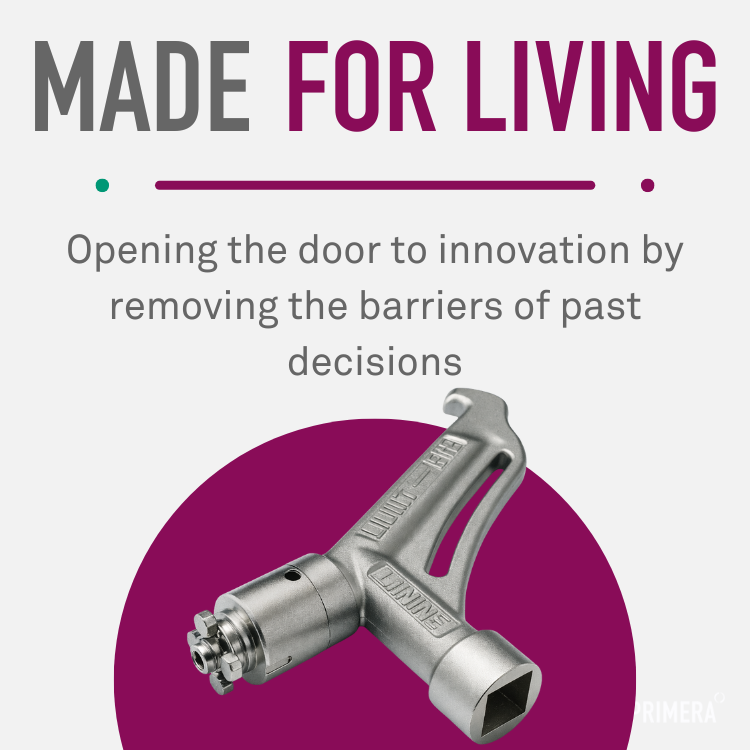
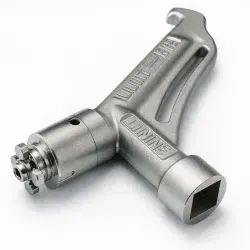
The brief: create a key that unlocks both staff only keyways with Safehinge Primera overrides as well as the typical square or oval drive overrides commonly found in mental health.
The hope: Producing a multi-key opens more than just doors, it also unlocks the freedom for trusts to choose.

Designing for good and real life of the ward
The design process pulled in real-world testing, on-site trials, and feedback from the people who actually carry keys every day. The people who feel the weight of them, replace them when they fail, and rely on them in moments that matter.
Crucial questions emerged from working closely with clinical staff such as:
How will the key sit on a secure key holder? How does it move around on a crowded keyring? How does it feel in the hand during repeated use? How much leverage does it provide when an override really matters?
And from estates teams we also heard:
How much will it cost to equip staff? How often do the keys need replaced? How reliable can a multi-key really be?
What started as a compatibility challenge became something else entirely. A better everyday tool. More comfortable. More durable. Easier to use.
Sometimes the biggest signal of good design is not that people notice it, but that they stop complaining about it.
See content credentials
The End Result
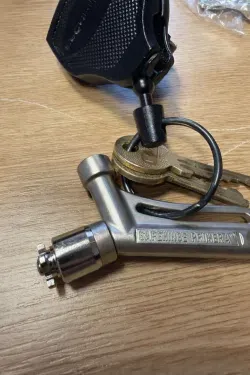
One safe key, instead of many
Carrying multiple keys creates unnecessary complexity for staff, increasing cognitive load and hesitation in situations where speed, confidence, and calm decision-making matter. A single, trusted override removes that friction and simplifies daily workflows on the ward.
“Our staff find the keys from our current supplier difficult and stiff to use when operating the anti-barricade system and are often complaining about sore hands, not to mention the keys wear away every few months and need replaced”
Comfort, durability, and usability
Beyond compatibility, the key is designed for repeated, real-world use. Its weight, grip, leverage, and durability matter to staff who use it throughout long shifts and in high-pressure moments. It is also designed to work with the secure key holders used by many staff.
“Compact by design and uncompromising in strength, Multikey brings together clinician-led ergonomics and carefully engineered leverage. The result is a single, durable key that feels intuitive in the hand, stands up to daily use, and supports a calm, confident response when it matters most.”
Freedom to move forward without adding risk
Taken together, the key removes a long-standing trade-off between safety and choice. It allows trusts to improve, adapt, and evolve without making daily life harder for staff or increasing risk.
“The key is very easy to use for staff. Being able to gain access in two seconds makes a huge difference for patients and reassures staff that they can support quickly when it matters.”
What this unlocks for people and places
At its heart, this is not a story about keys.
It is a story about agency.
For estates teams, it means being able to explore the market again. To test solutions on merit, not legacy. To make decisions that reflect today’s needs, not the constraints of yesterday’s decisions.
For staff, it means less friction. Fewer workarounds. One less thing that gets in the way of care.
And for the people living on wards, the impact is quieter but no less important. When systems work smoothly in the background, environments feel calmer. Decisions feel more intentional. Spaces feel considered, not compromised.
This is what Made for Living is really about.
Not adding more. Not changing everything.
But removing the small, invisible pebble that stop people making decisions based on the realities of today rather than the circumstances of the pasts.
Because when you give people the freedom to choose, without increasing risk, you do more than solve a technical problem.
You unlock the possibility of change and make the process of quality improvement.
We’re not selling the key. We’re sharing it.
This key isn’t a product you can buy. It’s something we built to solve a long-standing problem, and we’re keen to get it into the hands of the people who live with that problem every day.
That’s why we’re offering to send them your way.
Not as a sales offer, and not with strings attached. Simply as a way for you and your teams to experience it in real use, on real wards, in the moments where small details make a big difference.
Put it on a secure key holder. Use it across a shift. Let staff feel the difference for themselves.
If it subtly removes friction, reduces hesitation, or opens up new options you previously ruled out, that experience is far more valuable than anything we could explain in words.
Request a sample key
We’re keen to get these out, so if you’d like one to try in your environment, let us know and we’ll send it over.
Get in touch for your Multi-key!
Because sometimes the best way to understand good design is simply to live with it.
Industry Insights
Explore our latest articles and discover valuable information.